The heat/chemical shock transformation method is a quick, economical method for transforming (inducing cell uptake of) self-propagating DNAs (plasmids) and possibly linear non-propagating DNAs under conditions favoring integration into resident DNA.
The TSS method starts by cooling cell culture to arrest growth in exponential phase, in which the cell wall is least developed, facilitating passage of DNA. The cells are stored in TSS, a solution of: the rich nutrient medium LB, an organic solvent DMSO to permeabilize the cell membranes, the viscous polymer polyethylene glycol (PEG) to reduce DNA diffusion and facilitate binding to the cell, and a divalent cation salt, magnesium chloride, to neutralize the divalent charge of DNA phosphodiesters and LPS charge and disrupt protein–membrane/LPS interactions that occlude DNA binding. Cold temperature crystallizes the membrane, stabilizing pores called adhesion zones. The DNA to be transformed is added and incubated to give time for binding and penetrance of cells, facilitated by a heat shock that supposedly creates a temperature differential that induces flow that carries shielded DNA through adhesion zones. Recovery in non-selective medium allows expression of antibiotic resistance from the transformed DNA, necessary for survival of plated transformants on selective medium.
The TSS method produces highly competent cell for most E. coli cloning strains, yielding 106–107 CFU/µg pUC19 transformation efficiency in a 50 µL reaction, making for 0.01–0.1% of viable cells being transformed with ≈1∕100,000–1∕10,000 plasmid molecules.
Based on the Chung et al. protocol (1A, 1B, 1C) . Reviewed by Hanahan et al. (5) Modified by doubling cell concentration and adding heat-shock, which improve efficiency. Composed by Shyam Bhakta.
Competent Cell Preparation
Summary
Grow cells to OD 0.2–0.4. Centrifuge cold at a low speed. Resuspend in cold TSS volume 5–10% the culture volume. Aliquot.
For n transformations of v volume:
Materials
- Transformation/storage solution (TSS), ≥nv volume
Lysogeny Broth (LB) with 10% m/V PEG-3350, 5% V/V DMSO, 20 mM MgCl2, pH 6.5.
For 50 mL TSS from non-sterile components:- Dissolve 5.263 g PEG-3350 and
- 214 mg MgCl2·6H2O or 100.22 mg MgCl2 anh. or 1.053 mL 1 M MgCl2
- in a final 50 mL LB-Miller/-Lennox. Can microwave 15 s to help dissolution.
- Adjust pH to 6.5 using concentrated HCl. (pH 6.4–6.8 tionaltimum)
- Filter-sterilize.
- Remove any volume above 47.5 mL.
- Add 2.5 mL DMSO (auto-sterile, filter-incompatible)
- Store at 4°C.
- iGEM achieved 1e7 efficiency with >year-old TSS, so it's likely good for a few years.
- Dissolve 5 g PEG-3350 and
- 203.3 mg MgCl2·6H2O or 96.21 mg MgCl2 anh. or 1 mL 1 M MgCl2
- 2.5 mL DMSO
- in up to 50 mL LB-Miller/-Lennox.
- Filter-sterilize with nylon filter. Store at 4°C.
- 42.5 mL LB (autoclaved, RT)
- 5 g PEG-3350 in 5 mL H2O (filter-sterilized)
- 1 mL 1 M MgCl2 (autoclaved, RT)
- 2.5 mL DMSO (auto-sterile)
- Sterile rich growth medium (+antibiotic if necessary)
≥20nv volume LB or ≥7n v volume TB or LB30 - Culture tubes for precultures
- Culture flasks large enough to hold growth medium volume (detergent-free).
- Shaking incubator space for the culture flasks.
- Ice bucket/tray large enough to swirl flasks in. Access to ice.
- Chilled centrifuge bottles/lids or tubes appropriate for holding culture volumes and balancing. (detergent-free)
- Bottles must be able to collectively hold culture(s) without any exceeding ¾ capacity. Filling bottles higher will result in leakage into rotor.
- Chilled sterile water to balance multiple centrifuge bottles, if needed.
- 4°C centrifuge and rotor compatible with centrifuge bottles.
- (opt.) A serological pipette at -20°C for adding n v volume TSS before going to cold room.
- Labeled cryoboxes for comp cell aliquots, prechilled at -80°C.
- (opt.) Liquid nitrogen, dewar, and slotted ladle, if flash freezing.
- Materials on a mobile lab bench cart for the cold room:
- n tubes (e.g. 200 µL tubes) for cell aliquots, labeled/marked and arranged in clean tube racks or tip rack+boxes. Blade, if planning to cut apart tube strips.
- Extra tubes or bag of tubes, for aliquotting any excess comp cells, if desired.
- Serological pipette pump/controller and few 20 mL pipettes, for resuspending and transferring cells.
- (opt.) Electronic repeater pipette and a 5 mL combitip per strain and some extras. Reservoirs, if opting to us a multichannel pipette.
- A 50 mL tube per strain to hold resuspension.
- Micropipettor and tips appropriate for aliquot volumes ≥v. (Sometimes useful to aliquot remaining volume even when using electronic repeater pipette.)
- Ethanol spray
- Paper towels
- Extra gloves
- Trash bin/bag
- (opt.) If flash freezing, box/bag to collect all tubes in before flash-freezing.
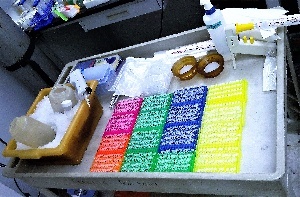
Procedure
- Grow preculture to saturation: inoculate ≥≈1/100 culture volume of rich medium (+selection, if necessary) with colony or frozen stock chunk, and incubate at growth temp (e.g. 37°C) shaking for ≥≈8 hr for LB.
- Use a fresh, trusted source of the strain. For the most reliable results, inoculate a seed culture from colonies from relatively fresh plates streaked from a frozen stock. Don't obtain from old plates; retransform necessary plasmid(s) or obtain directly from a frozen stock.
- Prepare growth medium and warm to growth temperature.
Prepare the mobile lab bench cart for the cold room as described. - Grow culture: inoculate 20nv mL pre-warmed LB with ≈0.2% seed culture (or ≈7nv mL TB/LB30 with same).
Incubate 37°C, shaking 250 rpm for flasks or 800 rpm for blocks.- 10–20 mM-Mg2+ in growth media considerably stimulates transformation efficiency (2) (3) .
- Lower growth temperature reduces efficiency considerably with the TSS method, based on comparisons of 22°, 30°, and 37° culturing [Shyam].
- Transformation efficiency from LB cultures decreases linearly between OD 600 =0.3–0.6. (1)
- Several tenfold lower-efficiency at stationary phase (105–107/µg DNA), but supposedly still fine for transforming pure plasmid or the simplest cloning.
- Can use Nanodrop to estimate OD initially and use a cuvette for accuracy when it gets close.
- Growth arrest: when in early log phase (OD₆₀₀≈0.2–0.35), swirl culture vessel in ice water bath for several minutes until 4°C to rapidly stop growth. It takes up to 20 min for 1 L volumes.
- Harvest: when culture is ice-cold, decant into prechilled centrifuge bottles and balance them. Use chilled sterile water if necessary.
Centrifuge cells 2500×g, 5–20 min (depending on volume) in a prechilled 4°C centrifuge. - Immediately check for a small pellet and gently decant medium away from the pellet, shaking the bottle to drain. Absorb the last of the medium on the lip with a paper towel, and quickly return bottles to ice.
Perform remaining steps with pre-chilled materials in a 4°C cold room for maximum efficiency. - Final resuspension: to the cell pellets, add 5% the original culture volume of 4°C TSS (n v mL). For TB/LB30 culture, 14% volume TSS.
Gently resuspend pellet in TSS using serological pipette, or P1000 tip if small volume. Keep bottle in contact with ice, only removing to check resuspension progress.
For large volumes, decant cells into 5 or 50 mL conical tubes on ice for easier access with pipette for aliquotting.- Flat-bottom centrifuge bottles allow easier gentle resuspension of pellets by pipetting against wall.
- Original protocol instructs 1–10-fold concentration in TSS. 20-fold as here, or even 40-fold increases transformation efficiency, but requires larger culture with diminishing returns in efficiency.
- Aliquot into tubes in the cold room (for top efficiency) or on cold block or ice. You can use a repeater pipette or multichannel pipette from a chilled reservoir. Swirl cells before aspirating to ensure homogeneity.
Cap the tubes while they are racked, and slice apart if using tube strips. Minimize touching the tubes to keep them cool. Check that all caps are fully in the tube.
Dislodge tubes from racks into a bag/box without touching the bottom (your hands are warm). This is easiest by pushing them out from the bottom using a spare rack or tip box. - Flash freeze ( opt. ) in liquid nitrogen for reportedly higher efficiency.
- Flash freezing is reported to retain higher competence of cells in the literature, but simply freezing is not estimated to greatly reduce competence, maybe within twofold [SPB].
- For a dry-ice-ethanol bath, residual ethanol fails to dry from tubes/boxes at -80°C. Flash-freeze tubes in a bag if using this method, and pour tubes into box.
- Store: quickly move tubes to prechilled, labeled -80°C freezer boxes, either directly from 4°C, or if flash freezing, directly ladled out of liquid nitrogen dewar or dry-ice/ethanol bag (so as not to heat tubes).
If not freezing, proceed to transformation right away.
Other Factors
Hanahan modifications(5):
The 20 mM Mg is made of both MgCl2 and MgSO4, just as in SOB/SOC.
LB-Lennox is used (maybe less Na helps).
Comp cells are incubated on ice for 20 min before aliquotting and DNA addition.
Detergent Residue
According to Tom Knight (4) : Detergent is a major inhibitor of competent cell growth and transformation. Glass and plastic must be detergent-free for these protocols. The easiest way to do this is to avoid washing glassware and simply rinse it out. Autoclaving glassware filled ¾ with deionized water is an effective way to remove most detergent residue. Media and buffers should be prepared in detergent-free glassware and cultures should be grown in detergent-free glassware.
Choice of Culture Medium
Shyam found that competent cells prepared from a TB culture produced far more satellite colonies in a transformation of pUC19[AmpR], compared to competent cells prepared from an LB culture, both plated on LB-amp100 plates. The effect was mostly apparent after plates sat at room temperature for several days.
ZymoBroth™ (3) , containing only 0.5–5% yeast extract and tryptone (LB components) and 10 mM MgCl₂, improves many strains' competence using an unspecified protocol, 13-fold for TG1, the NEB Turbo parent. MgCl₂ in the growth medium may thus be more effective than the 20 mM MgCl 2 in TSS is alone. Even before, Hanahan (1983) (2) found that "the presence of 10 to 20 mM Mg²⁺ in all growth media considerably stimulates transformation efficiency," as well as "incubation of the cells at 0°C in a solution of Mn²⁺ , Ca²⁺ , Rb⁺ or K⁺ , dimethyl sulfoxide, dithiothreitol, and hexamine cobalt(III)."
These enhancements were later found to be more specific to strain MC1061 and derivatives like DH10B, and not strains derived from Hoffman Berling strain 11008 ( e.g. , MM294, DH1, DH5) as well as from many other strains ( e.g. , HB101, C600), for which Mg²⁺ is not beneficial in the growth medium, and the addition of either DMSO or DTT to the transformation buffer reduces competence (5) .
Potential Transformation Enhancer
A patent from Stratagene(8) describes transformation efficiency being enhanced by adding a final 110 mM NaCl and 50 mM 2-mercaptoethanol (2-sulfanylethan-1-ol) to comp cells and incubating 10 min on ice before adding DNA and further incubating. Elsewhere, however, NaCl is described as being inhibitory to transformation (9) .
NEB writes (10) : Addition of 2-mercaptoethanol to cells at a final 24 mM from a high-purity, sterile 1.5 M stock has been shown to increase the pUC19 transformation efficiency of NEB 5-alpha by 140%. After cells are thawed on ice, add 0.8 µL 2-mercaptoethanol to cells, flick five times to mix, incubate 10 min on ice before proceeding with transformation and adding DNA.
Transformation
Summary for frozen lab aliquots
- Thaw comp cell aliquots (50 µL) slowly on ice or above cold block for a few min.
Use one aliquot per assembly reaction.
An aliquot can be split/distributed; 5 µL is sufficient to transform a purified plasmid. - Add DNA ≤5 µL. Flick five times to mix. Don't vortex or triturate.
- Incubate cold on 1°C block / ice for ≥5 min, best 30 min.
- Heat shock 42°, 30 s in a heat block or thermocycler.
- Return to cold immediately for 1–2 min. Can repeat steps 4–5.
- Recovery: remove from ice and add 150 µL SOC. Flick to mix.
Incubate at growth temp (e.g. 37°C) 45–60 min stationary. - Plate on selective agar and incubate.
Detailed
- Thaw -80°C comp cell aliquots on ice or atop cold block for a few min. Or use comp cells within hours of comp cell prep. Keep at 1–4°C except for heat shock and recovery.
- Slow thawing seems to give somewhat better efficiency; can thaw in the deli sitting on some plastic surface or scatter tubes on top of cold block, putting them in the metal wells after thawed.
- Unused volume of comp cells can be frozen back once and reused, albeit with some loss of competence. Lab aliquots are small/abundant enough not to merit this.
- Colony transformation with purified plasmid: pick several colonies or a clump of cells using a pipette tip, toothpick, or inoculation loop, and disperse cells into 50–100 µL aliquot of TSS. Incubate 1°C 10 min.
- Add KCM: optionally add cold 5× KCM to the cells to a final 1× (12.5 µL to 50 µL cells).
- Some preparations of KCM double DH10B efficiency while others are neutral.
- Bennett Lab KCM: ≈Twofold lower efficiency for NEB Turbo. Neutral for DH10B and OmniMAX. Somewhat improves transformation efficiency of DB3.1 (Shyam).
- Add DNA, aiming for ≤10% cell volume, normally ≤5 µL for 50 µL cells.
Flick five times to mix.- Do not vortex or triturate (pipette-mix).
- Incubate at 1°C (ice or cold block) for 5–30 min, with efficiency maximized by 30 min(1).
- Heat shock at 42°C for 20–30 sec in a heated block, thermocycler, or water bath.
- 20–30 s optimal for NEB Turbo and DH10B/10-beta (Shyam, NEB1, NEB2).
- 15–30 s found optimal for NEB Turbo (3E7 CFU/µg in water bath). Efficiencies fell for longer heat shocks in heat block: 28% loss for 45 s, 31% for 60 s, and 61% for 90 s (Shyam).
- Metal bead bath either needs a significantly different heat shock time or is inferior with too low conductance: 78% loss in efficiency in metal bead bath than water bath NEB Turbo 45 s heat shock (Shyam)
- 45–90 s purportedly better for some other strains.
- Folks on OpenWetware find heat shock improves efficiency 10–20 fold for TSS comp cells(4).
- 20–30 s optimal for NEB Turbo and DH10B/10-beta (Shyam, NEB1, NEB2).
- Immediately return to 1°C (ice or cold block) for 1–2 min.
Optionally repeat steps 5–6 for ≈twofold higher efficiency(6). - Recovery: Move to room-temp rack. Add 2–10 volumes room-temp recovery medium (no antibiotic); normally 3 volumes: 150 µL medium to 50 µL comp cells. Flick to mix. Trituration or very brief vortexing are probably ok.
- Open tubes without touching the insides, which have cells on them. Touching multiple tube lids can cross-contaminate the transformations.
- Adding 3 volumes (150 µL) SOC to lab standard 50 µL transformation aliquots in the original 250 µL tubes, flicking, and incubating stationary 37° gives about as good efficiency as recovering in 10 volumes SOC in a test tube incubated in a 37° horizontal shaker (Shyam).
- Fewer volumes of recovery medium can prevent having to switch to larger tubes than aliquot tube, but better recovery medium is then probably more important. Efficiency purportedly maximized by approaching 10 volumes recovery medium to improve transformation mix dilution, though shown otherwise.
- SOC, or rich media with added 20 mM Mg²⁺ and 20 mM glucose, are best. Media with poor carbon sources (LB, 2×YT) are ok. Mg²⁺, part of SOC, is said to improve efficiency by stabilizing outer membrane.
- β-lactam resistance transformations (ampicillin, carbenicillin) have ~tenfold less efficiency without recovery, so don't necessarily require it.
- Open tubes without touching the insides, which have cells on them. Touching multiple tube lids can cross-contaminate the transformations.
- Recovery: Incubate at growth temp (often 37°C) for 1 hour, optionally shaking. Recovery time can be reduced at the expense of efficiency.
- Lower efficiency obtained with 15–30 min recovery, no rich medium addition, poor rich medium addition (LB), or sometimes no aeration during recovery.
- Crack open the plate lids 30–45 min while incubating to dry them slightly, such that cell suspension liquid is quickly absorbed after plating.
- Transformants of plasmids with temperature-sensitive replicons will need to be grown at a lower, permissive temperature.
- Plating: Spread/streak a fraction of the transformation on selective agar medium (plates), optimally room-temp or warmed to growth temperature (often 37°C).
Store the remainder at 4°C in case later needed due to finding too few or too dense colonies on the transformation plate.- Prewarming the plate is said to slightly improve transformation efficiency, but the main advantage is the quick absorption of plated cell suspension, which may otherwise flow around the surface when moved. Wait until it is absorbed before inverting the plates, 15–30 min. You may leave the plates partially uncovered in the incubator and cover and invert them once dried. However, simply incubating them covered and non-inverted is also an option without any noticeable negative consequence, allowing you to not further monitor the plates.
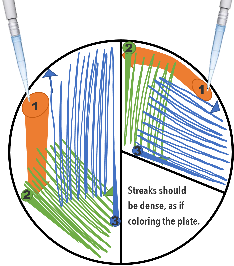
- Spread or streak only as much as can fit on the plate/sector without either flowing into neighboring sectors or inhibiting streaking dilution such that single colonies are not obtainable (the case with higher efficiency transformations).
- Save resources; use half to a third the number of plates by plating transformations on half/third-sectors of plates. ☮
- Prewarming the plate is said to slightly improve transformation efficiency, but the main advantage is the quick absorption of plated cell suspension, which may otherwise flow around the surface when moved. Wait until it is absorbed before inverting the plates, 15–30 min. You may leave the plates partially uncovered in the incubator and cover and invert them once dried. However, simply incubating them covered and non-inverted is also an option without any noticeable negative consequence, allowing you to not further monitor the plates.
- Incubate agar plates inverted in an incubator or room of the appropriate growth temperature until there is sufficient growth.
- Pickable colonies form with MG1655, JS006, or NEB Turbo in 9–10 hr. Other strains like DH10B, other Rec– strains, and Mach1 may require 15–16 hr.
Thermocycler Heat/Cold Shock Protocol
After incubating cells + DNA on ice or cold block, add to thermocycler block prechilled to the first step and proceed to the next step. This is less taxing on the thermocycler, not built for sustained low-temp holds.
| Unheated lid | |
| 1°C | 5–30 min Try to do this cold incubation on ice/cold block instead. |
| 42°C | 20 sec |
| 1°C | 1–2 min |
| 42°C | 30 sec ; beep |
| 1°C | 1–5 min ; beep |
| END | Add recovery medium and grow in incubator (steps 8–11). |
Recovery
Transformation recovery is generally prescribed to consist of adding the transformation suspension to 9–10 volumes prewarmed recovery medium and shaking for 1 hr.
Home-made CCMB comp cells appear to do as well if not better with just 2–3 volumes recovery medium added to the 250 µL "PCR" tubes that transformations are often performed in for space efficiency, thermocycling flexibility, and multichannelability of DNA in tube strips into comp cell aliquots.
50 μL chemical transformation of a Golden Gate assembly, split in half before recovery at 37°, 1 hr.
Left: recovered in 3 volumes SOC in PCR tube, sitting static in bead bath in incubator.
Right: recovered in 9 volumes SOC in 0.6 mL tube, rotating/inverting in incubator.

Original Protocol from Chung et al. (1)
- Prepare transformation/storage solution (TSS), if not already prepared. (LB, 10% (W/V) PEG-3350, 5% (V/V) DMSO, 20–50 mM MgCl2/MgSO4, pH 6.5)
- Grow seed culture.
- Inoculate prewarmed LB 1:100 with saturated culture, and incubate 37°C, 225 rpm to an OD600 0.3–0.4.
- Tenfold less efficiency at OD600 0.55.
- Several tenfold lower efficiency in stationary phase, but still ok.
- Add equal volume ice-cold 2× TSS to a final 1×, or concentrate culture in 1 – 1∕10 volume ice-cold 1× TSS
- 10× concentration is ≈twice as efficient as 1×.
- Adding 2× TSS will half the cell concentration.
- For long-term storage, flash-freeze in a dry ice/ethanol bath and store at -80°C.
- For transformation, pipet 100 µL into a cold polypropylene tube containing 1 µL (100 pg) plasmid. Mix gently. (When frozen cells are used, cells are thawed slowly on ice and used immediately.)
- Incubate cell/DNA mixture 5–60 min at 4°C.
- Efficiency maximizes by 30 min, supposedly 4–5-fold over 5 min incubation.
- [People on OpenWetware and most labs find heat shock improves efficiency 10–20 fold for TSS comp cells(4). It is unclear why the authors did not find the same in their trials.]
- Allow cell recovery in equal volume TSS (or LB 20 mM glucose).
- A: Chung, C. T., Suzanne L. Niemela, and Roger H. Miller. "One-step preparation of competent Escherichia coli: transformation and storage of bacterial cells in the same solution." Proceedings of the National Academy of Sciences 86.7 (1989): 2172-2175. doi.org/10.1073/pnas.86.7.2172
Chung, Cathie T., and Roger H. Miller. "[43] Preparation and storage of competent Escherichia coli cells." Methods in enzymology 218 (1993): 621-627. doi.org/10.1016/0076-6879(93)18045-E
B: Chung, Cathie T., and Roger H. Miller. "[43] Preparation and storage of competent Escherichia coli cells." Methods in enzymology. Vol. 218. Academic Press, 1993. 621-627. doi.org/10.1016/0076-6879(93)18045-E
C: Chung, C. T., and Roger H. Miller. "A rapid and convenient method for the preparation and storage of competent bacterial cells." Nucleic acids research 16.8 (1988): 3580. doi.org/10.1093%2Fnar%2F16.8.3580 - Hanahan, Douglas. "Studies on transformation of Escherichia coli with plasmids." Journal of molecular biology 166.4 (1983): 557-580. doi.org/10.1016/S0022-2836(83)80284-8
- ZymoBroth https://www.zymoresearch.com/zymobroth
- “Transforming chemically competent cells.” OpenWetWare, openwetware.org/wiki/Transforming_chemically_competent_cells.
- Hanahan, Douglas, Joel Jessee, and Fredric R. Bloom. "[4] Plasmid transformation of Escherichia coli and other bacteria." Methods in enzymology. Vol. 204. Academic Press, 1991. 63-113. doi.org/10.1016/0076-6879(91)04006-A
- Panja, Subrata, et al. "How does plasmid DNA penetrate cell membranes in artificial transformation process of Escherichia coli?." Molecular membrane biology 25.5 (2008): 411-422. doi.org/10.1080/09687680802187765