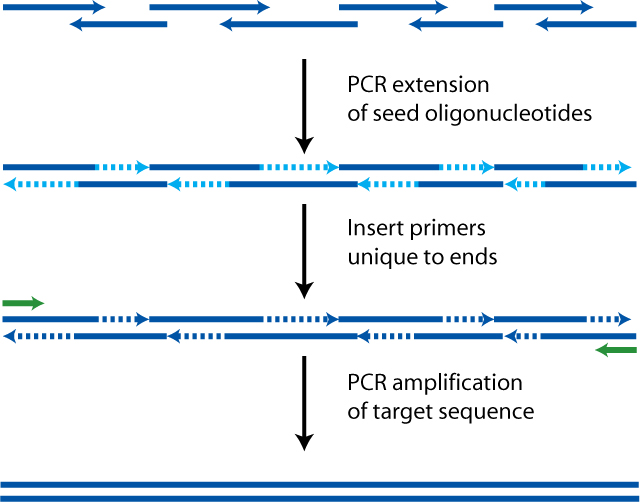
Polymerase chain assembly (PCA), also known as polymerase cycling assembly or PCR assembly, is useful in the de novo (template-less) generation of shorter linear DNA parts (<500 bp) by extending many partially-overlapping oligonucleotide primers off one another in a PCR to generate the full linear product. While the smallest parts are more cost-effectively generated by annealing pairs of oligonucleotides, PCA can be more efficient for longer small parts, as the polymerase in PCR synthesizes DNA segments between successive primers/amplicons on each strand using the opposite strand's primers/amplicons as templates, DNA which needn't be purchased pre-synthesized as oligos as when making oligo annealing products, for which every nucleotide of both strands must be purchased in oligos. Oligo annealing products, however, can be designed to intrinsically have cohesive "sticky" ends / overhangs, allowing them to omit the DNA encoding restriction sites for downstream assemblies, saving some cost compared to PCA, which just as any PCR product, requires including flanking restriction sites if using in restriction-based assembly such as Golden Gate.
For cost-minimization, compare the following:
- Cost of oligo-anneal product =
($/nt) × 2 × (lengthpart + lengthoverhang)- For typical part assembly, "part length" includes 2 flanking latent BsaI overhangs, but not the one ssDNA PaqCI overhang per strand.
Thus, for a pure, part-only sequence: ($/nt) × 2 × (12 nt + lengthpart-only)
- For typical part assembly, "part length" includes 2 flanking latent BsaI overhangs, but not the one ssDNA PaqCI overhang per strand.
- Cost of PCA product = ($/nt) × Σ(all PCA primer-lengths), where primers are designed in Primerize with any necessary terminal restriction sites and end-spacers.
- For typical part assembly, part-only sequence can be input into Primerize, primer lengths summed, and 34 nt added for the two 17 nt part adapters in the outermost primers.
PCA Primer Design with Primerize
Use the online Primerize software to quickly design PCA primers.
- Make sure "check for T7 promoter" is unchecked, as this option adds a T7 promoter sequence to the design.
- Ensure any restriction sites (e.g. Golden Gate sites) or Gibson homologies are included at the ends as with any PCR product to be used in a later assembly.
- Primers are best kept ≤60 nt, as per-nucleotide price and synthesis/delivery time typically increases for >60 nt primers, as well as synthesis error rate.
- The PCA reaction protocol can be followed as described but with Q5 PCR components, and the 50 µL reaction size can be scaled down (along with primers) to 20 µL with sufficient yield. The reaction is essentially a PCR containing all the designed primers but with 4–8× more outer primers and 12.5× less inner primers, thus 50–100× more outer primers. For PCAs with only two primers, both are outer primers.
- For cases where mispriming warnings are shown, consider the stepwise "multiple-round" PCA methods described, wherein two or more partially overlapping subfragments are first separately generated in "sub-pools", purified, and combined in a final PCA to make the full product. In the case Strategy 1: '2-Round' method does not work or is not predicted to due to the nature of the potential mispriming, the Strategy 2: 'Couple' reacts only pairs of primers first to make fragments for the final PCA.
PCA Setup
- PCA rxn (Primerize): 4 µM outer primers, 0.04 µM inner primers, Phusion
- PCA rxn (Shyam):
- 2 µM outer primers (4× typical Q5 0.5 µM) from 100 µM stocks.
- 0.04 µM inner primers (¹∕₁₂.₅× typical Q5 0.5 µM) from 2 µM dilution.
- Primer mix
- Method 1: Make a 2 µM inner primer mix, used as 50×:
combine 1 µL of each 100 µM inner primer + water up to 50 µL.
(Outer primers at 100 µM are already 50×.) - Method 2: 10× primer mix
for 12 µL of 10× primer mix, combine:- 4 µL 100 µM outer primer 1 (20 µM)
- 4 µL 100 µM outer primer 2 (20 µM)
- 4 µL 2 µM inner primer mix (0.4 µM each)
- Method 1: Make a 2 µM inner primer mix, used as 50×:
- Prepare a Q5 PCR master mix cold, accounting for 4× the typical primer volumes.
- For a 25 µL rxn, add:
- 0.5 µL 100 µM outer primer 1 (2 µM final)
- 0.5 µL 100 µM outer primer 2 (2 µM final)
- 0.5 µL 2 µM inner primer mix (0.04 µM final)
- — OR for Method 2, 2.5 µL (¹∕₁₀ rxn volume) 10× primer mix
- Thermocycling:
- Regular PCR program: lowest Tanl for all cycles.
- 2-phase PCR program: lowest Tanl for first phase, outer primer Tanl for second phase
- 2-phase PCR program, outer primers spike-in: reaction prepared with all primers at 0.04 µM. First third of cycles uses the lowest Tanl. Outer primers are then spiked in at 2 µM and the remaining cycles use the outer primer Tanl.
- 2-round PCA: prepare separate reactions for each subpool, with one or more pairs of primers in each. If not purifying these, assume the products are 2 µM, just as the outer primers used in them. In the final PCA, use these subpool products as 50× for a final 0.04 µM, just as inner primers are in a one-pot PCA. Add a final 2 µM outermost primers as usual.
- Lowest Tanl amongst primer and fragment overlaps is calculated for 0.04 µM primers, which lowers it 2–3° from the default Q5 500 nM primers. Primerize seems to design with 60° Tanl when set for 58°.
- Outer primer Tanl is calculated for 2000 nM primers, no higher than Text = 72°.
- DMSO: reduce Tanls by 3° for 5% DMSO, 6° for 10% DMSO, when using it to inhibit secondary structure.
- NEB Tm Calculator