Oligo assembly and Polymerase Chain Assembly (PCA) are both options for building relatively small dsDNA fragments for use in DNA assemblies. In oligo assembly, oligonucleotides are purchased, annealed, and enzymatically phosphorylated (if not purchased phosphorylated), to produce the fragment. Oligo assembly and PCA are useful in the following cases, where the desired sequence is:
- Sequence is too small to PCR from a source (≲50 bp), at which point the fragment be difficult to resolve on a gel from incorrect primer multimer products and can thus be troublesome to purify.
- Sequence is repetitive or too structured toward the ends where PCR primers would bind. Primers would misprime and make an incorrect PCR product. PCR can still be used to amplify a larger, nonrepetitive segment (as in example 2), so as to save on oligos, but the repetitive segment(s) still must be made by oligo assembly or PCA.
- Sequence is uneconomical or too slow to obtain from a DNA fragment synthesis service (e.g. Twist, Genscript, IDT gBlocks/synthons). Services seem to have a higher price per base for tiny products. You can make it yourself within hours after receiving your oligos tomorrow.
To be formalized eventually. For now, here's a Slack post from Shyam Bhakta explaining the process. Somehow I manage to complicate even annealing oligos together.
NEB says to phosphorylate oligos by adding 300 pmol 5′ termini with 500 nmol ATP, 1 µL T4 PNK, 1× PNK buffer, in a 50 µL rxn. PNK has full activity in T4 ligase buffer, which also supplies sufficient ATP. We don't keep ATP aliquots around anyways to use PNK buffer. So just use ligase buffer.
I anneal pairs of oligos first to ensure their 5′ termini are exposed in the duplex for later phosphorylation. However, most sources individually phosphorylate oligos first, assuming the 5′ ends will be exposed in whatever 2° structure the oligo adopts at the 37° phosphorylation temp; then they anneal the phospho-oligos. I don't make this needless assumption, which might invite failure, and doubles the reaction tubes.
Anneal oligo pairs in water, or restriction buffer or Tris buffer/EB as I think ought to be better due to buffering and salts, at ~2.5 µM oligo in ~10 µL. That's 0.25 µL of each 100 µM oligo (=25 pmol each oligo = 50 pmol total termini). Run the thermocycler anneal program. The long 25 min program might be "better" than the short 10 min one, but in practice, the short one has been fine for making even terminator parts with strong secondary structure. Unnecessary high temp exposure to ssDNA ought to be minimized anyhow, as it's mutagenic. The longest protocol, used classically to anneal DNA probes to DNA mixtures, involves placing the tubes in a beaker of boiling water or in a heated 95°C block, and letting the water bath or heat block cool to room-temp.
After annealing, the annealed oligos are phosphorylated by spiking in 10× T4 ligase buffer to a final 1× along with a minimal amount of T4 PNK. If the annealing was done in ligase buffer, the ATP will have been destroyed, so replenish with more ligase buffer or just ATP. 50 pmol termini can be phosphorylated by 1/6 µL T4 PNK. You can round up to ¼ µL since that's the minimal pipettable, or you can make a master mix of 2× buffer and enzyme and add it to the annealing reactions (10 µL MM + 10 µL annealed oligos). Incubate 37° ≥30 min. I let it go for 1–2 hr if I can. Do not heat-inactivate the reaction, which may denature the oligo duplexes.
Now the phosphorylated, annealed ds-oligo product should be at a bit less than the initial 2.5 µM (due to the small added volumes, or 1.25 µM if you added a 2× master mix's volume). A 1:25 dilution into water or TE would put this product just under two-fold (~100 nM) my prescribed concentration for Golden Gates (50 nM). This can conveniently be done by adding 240 µL water to the top of each rxn. The PCR tube cannot hold any more volume. Any more concentrated the previous reactions' oligos, and you'd need another tube to make a dilution. That or just use <0.5 µL when you use it, or end up using >25 fmol in the GG with no issue.
What I thus give you is a one-pot, sequential annealing-phosphorylation reaction, more efficient by its use of three less "pots" and tips per rxn and half the enzyme than what my great predecessors taught me.
Annealing:
- (Choose a or b for annealing and phosphorylation steps)
- For one or a few reactions:
Combine 0.5 µL each of two 100 µM oligos with 17 µL buffer*. Or 1.8 µL 10× buffer* + 15.2 µL water. Final 18 µL. - If using a PNK master mix later (better for many rxns):
Combine 0.5 µL each of two 100 µM oligos with 9 µL buffer*.
- For one or a few reactions:
- Thermocycle to anneal as described in the tables below.
* Buffer: 1× NEBuffer CutSmart or Thermo Tango restriction digest buffer, 1× NEBuffer 3.1 (high-salt), 1× T4 ligase buffer, or ½–1× DNA Tris elution buffer. See Annealing Buffer section.
Best to keep a tube of 1× CutSmart handy for annealing (store 4°).
Plain water or EB will usually do fine, unless the oligos are very short, low Tm.
Phosphorylation: - To each 18 µL anneal, add:
2 µL 10× ligase buffer + 0.25–0.5 µL T4 polynucleotide kinase (PNK). - Or to each 10 µL anneal, add:
10 µL 2× PNK master mix:
n rxns × (7.75 µL water, 2 µL 10× ligase buffer, 0.25 µL PNK)
* If ligase buffer was used for annealing, 10 mM ATP can be used instead of more ligase buffer.
- To each 18 µL anneal, add:
- Mix, spin down, and incubate 37°C, ≥30 min. Do not heat-inactivate.
T4 PNK heat-inactivation isn't useful, and the high temperature risks denaturing the DNA. - Add 230 µL buffer* to get a final 250 µL, such that the annealed oligo product is 200 nM.
Or add 180 µL buffer for a final 250 nM.
Use 0.25–0.5 µL in assemblies where 25 fmol / 0.5 µL 50 nM parts would usually be used. The higher concentration of oligo product is fine.
| Anneal, fast | ||||
|---|---|---|---|---|
| Step | Temp | Time | Notes | |
| Lid | 100°C | – | ||
| 1 | Start | 90° | 1 sec | |
| 2 | Slow ramp | 37°, 0.1°/sec | 1 sec | slowly ramp 94° to 37° |
| × | End | Move to 4°C and use promptly. | ||
| Anneal, slow | ||||
|---|---|---|---|---|
| Step | Temp | Time | Notes | |
| Lid | 100°C | – | ||
| 1 | Start | 90° −0.2°/cycle, 0.1°/sec | 5 sec | Libraries: slower −0.1°/cycle requiring 530 cycles + longer 10 sec hold. Quadruples the 24 min time. |
| 2 | Go to #1 | – | 285× | ncyc = (94°–37°)÷(0.2°/cyc) = 265. More cycles if ramping to lower temp. |
| × | End | Move to 4°C and use promptly. | ||
Thermocyclers can most slowly ramp temp at 0.1°/sec, which would finish ramping from 90°C to 37° (ΔT=53°) in 9 min. This works for most anneals. Anneal products that have large, strong hairpins, repeats or degenerate bases/libraries would anneal more accurately if done slowly: ramping slowly and cycling down the temp only 0.1–0.2°C per cycle (ΔTcyc), holding each cycle for 5–10 sec, starting from full denaturation at 90°C (Thi) and ending at 37°C (Tlo). Calculate the number of cycles: (Thi – Tlo) ÷ ΔTcyc = ncyc .
The fast anneal protocol has been flawless for cloning strong single terminators.
Products will have to remain annealed at 37° for most reactions, so there's no reason to ramp to room temp. Traditional annealing methods would be to boil water in a beaker and float the reaction tube in it until the water cools down. Or place the tubes in a 95°C block heater and turn the device off to cool slowly to room-temp. For the small volumes worked with nowadays, water evaporation and condensation on the tube lids may pose a problem, hence using a thermocycler. Burying tubes in a heated bead/sand bath may be an alternative that allows uniform tube heating.
Annealing Buffer
Annealing oligos in water is a common practice that works. However, it is probably more robust to use a buffer to protect the oligos and exposed cohesive ends, especially when exposed to high temp during annealing. Traditional high NaCl, EDTA annealing buffer is absolutely not necessary or advantageous for oligo assembly, and the salt and EDTA can be bad for downstream usage of the oligo product. Common DNA elution/storage and restriction/ligation buffers make for fine annealing buffers and diluents. They keep oligos at a safe pH and provide helix-stabilizing ions.
For annealing of oligo products, ½× buffer concentration may be a bit better when annealing in 10 mM Tris buffer (EB/TE) so that its higher pH (8–8.5) doesn't affect later phosphorylation in pH 7.5 ligase buffer. Ligase buffer is however fivefold the buffering capacity (50 mM), so it doesn't seem to generally matter to use full 1× Tris buffer for simplicity. This of course doesn't matter if the oligos are pre-phosphorylated.
Annealing oligos in ligase buffer or NEB CutSmart / Thermo Tango (or similar restriction buffers) adds in 10 mM Mg²⁺, which substantially increases the Tm of oligos. NEBuffer 3.1, the high-salt restriction digest buffer, has an additional 100 mM NaCl that also increases the Tm of oligos. Salt (monovalent cations) and the Mg (divalent) help anneal shorter oligos whose Tm would otherwise be too close to room temp or reaction temp (37°C). In such a case, dilute the annealed product with the same 1× NaCl/Mg-containing buffer, as diluting short DNAs with water may denature them.
Very Short Oligo Products / Low T m
Oligo products are generally designed to be annealed at least several °C above 37° in order to be compatible with phosphorylations and Golden Gate reactions / digestions that operate at 37°. Even higher Tms would be necessary for products to be used in higher-temp reactions like Gibson isothermal assembly. Oligo products designed with low Tms, (very short) might anneal at a lower temp, minimally above room temp, 25°. One might have to be careful even holding such products in hand, lest it denature them. Be sure to anneal and dilute very short oligo products in Mg/salt-containing buffers as discussed previously. Should problems arise, you might consider phosphorylating such oligos before annealing, order them phosphorylated, or re-anneal after phosphorylation just to be sure.
Examples
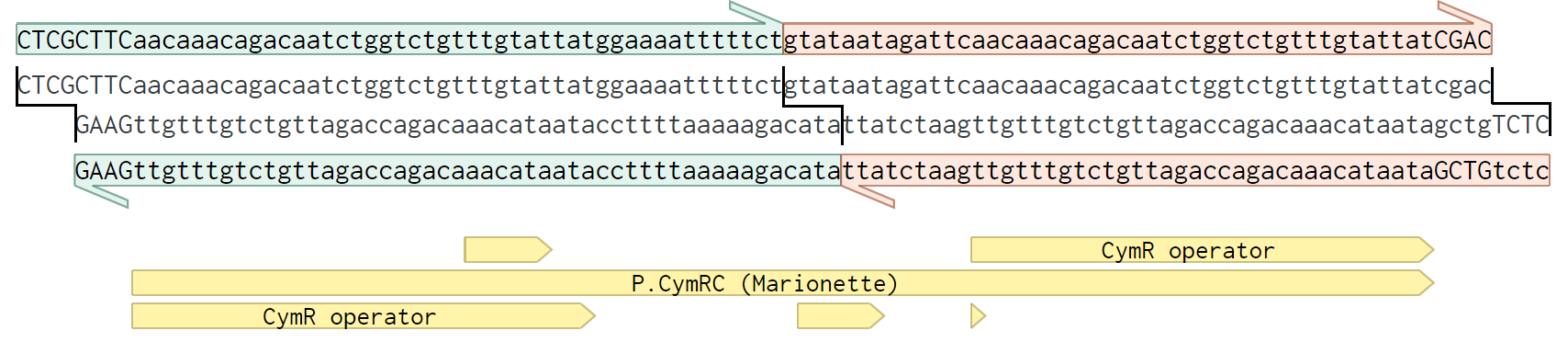
This promoter with two identical operators at the ends would be impossible to PCR from a template, as each primer has two binding sites in the template and would bind one another and possibly themselves because the operators are roughly palindromic. PCA is also failure-prone because of the same: Primerize warns of mispriming and suggests two stages of assembly, with separate synthesis of two halves of the promoters which are then combined in a final stage. This may work, but the two 35 bp operator repeats might still cause unexpected mispriming at the final stage due to the large sequence identity in the two fragments.
Oligo assembly is most reliable in this case due to the separate and simple, single-instance annealing of each half of the promoter, completely specified within the oligos – no reliance on DNA polymerase to produce sequence a certain way based on sequence-dependent complexity and specificity of DNA annealing for priming.
The two green oligos and two red oligos are individually annealed in buffer, phosphorylated with PNK, diluted and used directly in the assembly (Golden Gate or plain ligation) as two fragments with exposed ssDNA cohesive/"sticky" ends, aka "overhangs". The outer overhangs connect the fragments to upstream and downstream DNA (in this specific example, the part acceptor vector).

This example shows four fragments, three of which are annealed oligo products (red, orange, blue pairs), and the last fragment is a PCR product (using green primers). The four fragments plus a vector (not shown) were assembled together in a BsaI Golden Gate reaction.
Overhangs A and E connect to the vector, which has its own BsaI sites generating complementary overhangs.
Overhang B connects the two fragments (red and orange) encoding the two halves of the strong hairpin terminator T917, which could not be made as a single-pair oligo product, presumably because it has too long of a perfectly palindromic sequence (also making it impossible to prime in PCA or PCR). The two longer oligos perhaps prefer to each form a monomeric hairpin helix than a dimeric helix. Breaking the sequence into two fragments eliminated this problem, as the two fragments split the halves of the palindrome/hairpin.
Overhangs C and D connect the orange and blue oligo fragments with the PCR product generated by the green primers (amplifying from some DT54 template), after the PCR product's BsaI sites (boxes in green primers) generate the sticky ends C and D in PCR product during the BsaI Golden Gate assembly reaction. DT54 thus did not have to be made by oligo assembly or PCA, which would require more oligos.