Before we get started
Introduction
This guide is intended for all Technical Service staff who interact with serials.
A note about terminology
In cataloging, serials are titles that are issued in successive parts and have no predetermined end (such as journals and magazines, newspapers, and monographic series). A periodical is a type of serial, and the word is often used to mean magazines and journals, collectively. The library's Acquisitions department uses the terms "serial" and "periodical" in a slightly different way; they are used with PO lines to specify how an order should be handled by Acquisitions staff. In these instructions, serial will be used in the cataloging sense and not restricted to the "serial" order type.
Serials are issued in a variety of units (issues, volumes, parts, etc.) so for simplicity's sake these instructions will use the term issues.
General information about call numbers
Basic call number structure
The basic structure of a call number for a serial consists of three parts, usually in this order: (1) base call number, (2) enumeration, (3) and chronology.
- The base call number indicates the serial's subject matter and is shared by all issues. The base call number should be consistent for all shelf locations. For example, if a journal has holdings in STACKS, WRC, and LSC, the base call number should be the same in all three locations.
- Enumeration is how the issues are numbered. Frequently the enumeration consists of a volume number and issue number, with each volume comprised of multiple issues.
- Chronology specifies the date designation of the issue. Frequently this consists of the year and month.
Here is a simplified example of a call number for a recent issue of a journal (Rice Algebra Review, made up for this example) published annually on the topic of Algebra: QA150 .R53 v.13 2024.
Terminology used in call numbers
Terms for issues and completeness
The terms for units are also called "captions."
| Term | Use |
|---|---|
| volume/volumes | v. Lowercase. Do not follow with a space. |
| number/numbers | no. Lowercase. Do not follow with a space. |
| part/parts | pt. Lowercase. Do not follow with a space. |
| series | s. Lowercase. Do not follow with a space. |
| supplement | Suppl. Capitalized. If the item is a supplement to a specific issue, put "Suppl." after the designation for the issue. For example, a supplement to volume 12 of a journal would be "v.12 Suppl." A supplement to a range of volumes would be "v.10-20 Suppl." A supplement to the 2012 issue would be "2012 Suppl." If the item is a general supplement that is not associated with a specific issue, "Suppl." appears first (immediately after the base call number) and is optionally followed by a designation that differentiates it from previous supplements. For example, if a general supplement had already been published that has "Suppl." in the call number, a newly published one may be "Suppl. 2025". |
| index | index Lowercase. Do not abbreviate. If the index covers a specific range of issues, follow "index" with the range. For example, an index to volumes 10-20 would be "index v.10-20". |
| incomplete | inc. Lowercase. Avoid using whenever possible and instead list the actual contents of the bound volume when practical. Should always be the last element in the call number. |
Terms for months and seasons
Months longer than four letters are abbreviated. Seasons are neither capitalized nor abbreviated. Please note that different rules may apply to months and seasons in languages other than English; rules for non-English terms can be found in RDA documentation.
| Term | Use |
|---|---|
| January | Jan. |
| February | Feb. |
March | Mar. |
April | Apr. |
May | May |
June | June |
July | July |
August | Aug. |
September | Sept. |
October | Oct. |
November | Nov. |
December | Dec. |
Spring | spring |
Summer | summer |
Fall, Autumn | fall, autumn |
Winter | winter |
Input conventions for call numbers
Rules that apply to all items
| Rule | Examples |
|---|---|
| Replace non-English terms for units (Band, tomo, etc.) with the English equivalent. |
|
| Do not add a space between the abbreviation for a unit and the numbering. |
|
Convert numbers expressed as words and roman numerals into Arabic numerals. |
|
Do not enclose chronology in parentheses. (Chronology is only enclosed in parentheses in holdings records.) |
|
Use a forward slash to indicate issues that were published together. Do not use slashes for issues that we sent for binding. (Slashes can be used in holdings records for bound volumes.) |
|
| Add a space between enumeration and chronology. Add a space between levels of enumeration and chronology. |
|
Additional rules that apply to bound volumes
| Rule | Examples |
|---|---|
| Specify ranges in volumes we sent for binding by using a hyphen. For enumeration, do not repeat the unit abbreviation. For chronology, do not repeat the first 2 digits of the end year if they are the same as the start year. |
|
If issues are missing, record them in the call number when practical. If impractical, use "inc." in the call number instead and note the missing material in the holdings record. Commas are used to indicate gaps in the holdings. For spine labels (which is determined by the item description), do not add a space after the comma. |
|
How to edit holding records for serials
For serials, holdings records tell us which issues we should have and where they are shelved. This section is included on this page because holdings records and item records are closely linked; the holdings record should accurately summarize the items that are held in that specific location and provide valuable information about the disposition of items.
Editing holdings records when receiving new issues
When new issues are received, the holdings records should be updated to reflect the additions. In most cases, adding a new issue only requires minor editing of the holdings record. Here is an example of how a holdings record would be updated upon receipt of a new issue (volume 47, 2025):
Before:
866 41 $$8 0 $$a v.1 (1979)-v.46 (2024)
After adding a new issue:
866 41 $$8 0 $$a v.1 (1979)-v.47 (2025)
See the Cataloging Manual page on MARC Holdings Records for details about more complex edits to holdings records, including how to indicate gaps in the holdings, adding supplements and indexes, and input conventions.
Editing holdings records when issues are bound
When items are bound, it is usually not necessary to edit the holdings record because the issues we have do not change. Only the way the issues are grouped changes, and this information is recorded in the item record. However, here are some exceptions:
- The holdings record is not up to date. It is good practice to verify that the issues being collated for binding have been recorded in the holdings record. If issues are missing, add them to the holdings record.
- The bound volume is missing material (in other words, it is incomplete). The best time record missing material is when issues are being collated for binding because the issues are readily at hand. Check the holdings record to verify that missing issues have been noted. See below for more information about incomplete bound volumes.
- Bound volumes are shelved in a different shelf location than unbound issues. In these instances, update the holdings records for both locations to reflect the move. If a holdings record does not yet exist for the destination location (for example, if bound issues should be sent to the LSC but an LSC holdings record has not been created), notify C&MS to create one.
Editing holdings when serials move from one location to another
When items are moved from one location to another (such as PER-3RD to STACKS, or STACKS to LSC) the holdings records for both locations should be updated to reflect the move. If a holdings record does not yet exist for the destination location (for example, if bound issues should be sent to the LSC but an LSC holdings record has not been created), notify C&MS to create one. Yes, this is repeated information from the previous section.
How to record call numbers in item records
Be consistent!
Many of the call numbers we use for serials do not follow the standard call number structure due to a variety of reasons. When formulating a call number for an issue, the most important rule to follow is BE CONSISTENT and follow the format that was used with previous issues, even if the format does not follow current practice. The only exception to the BE CONSISTENT rule is when the publication changes its enumeration or chronology (for example, if the title changes from having volume numbers and year designations to only having years). In these cases, the issue should be given to C&MS staff to review.
Editing item records
Item records in Alma are more robust than in previous library management systems and contain information that both Alma and Primo require to properly display our inventory to staff and patrons.
Item record fields (screenshot)
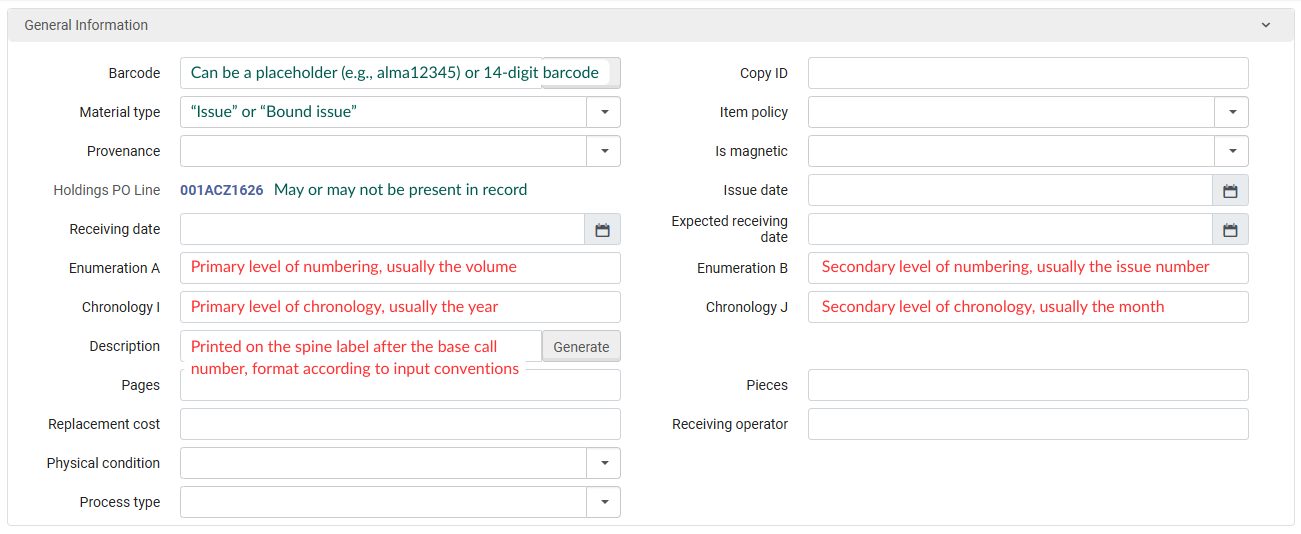
Item record fields details
| Field | Description | Examples |
|---|---|---|
| Enumeration A | The primary (broader) level of numbering. Also use this field if there is only one level of numbering. Enter the number only–-do not include captions. For all fields: Ranges are indicated with slashes (for issues published together) or hyphens (for issues later bound together). If a bound volume contains issues published together as well as other issues, only use a hyphen. |
|
| Enumeration B | The secondary (narrower) level of numbering. Leave this field empty if there is only one level of numbering. Enter the number only–do not include captions. |
|
| Chronology I | The primary (broader) level of chronology, usually the year. |
|
| Chronology J | The secondary (narrower) level of chronology, usually the month or season. Leave this field empty if there is only one level of chronology. |
|
| Description | This field is printed on the spine label immediately after the base call number, so include captions. Be consistent and format the description to include the same levels of enumeration and chronology and the same captions as previous issues or bound volumes. Follow the input convention rules above to format this field. Note: The description does not have to include all elements from the enumeration and chronology fields. |
|
Editing item and holdings records for incomplete bound volumes
Extra care is required when handling records for incomplete bound volumes of serials. In alignment with Ranganathan's 4th law of library science ("Save the time of the reader"), the missing material should be clearly communicated to users so that they don't have to thumb through the item in order to see what is missing. The missing issues should have already been noted in the holdings record as part of the normal receiving process, but always verify that the information is actually there and edit the holdings record if necessary. Add a public note to the item to indicate the missing content:
Example: A serial is published 4 times a year and issues are sent for binding as each year is completed. However, issue number 3 from volume 19 (2024) is missing.
Here is how the item record should be configured:
- Enumeration A = 19
- Enumeration B = 1-2, 4
- Chronology I = 2024
- Chronology J = blank
- Description = v.19 2024 inc.
- Notes tab > Public note = v.19 no.3 missing
Example: A serial is published monthly and issues are sent for binding as each year is completed. However, the August issue (number 8) is missing from volume 5 (1994).
Here is how the item record should be configured:
- Enumeration A = 5
- Enumeration B = 1-7, 9-12
- Chronology I = 1994
- Chronology J = Jan.-July, Sept.-Dec.
- Description = v.5 1994 inc.
- Notes tab > Public note = v.5 no.8 (August 1994) missing